
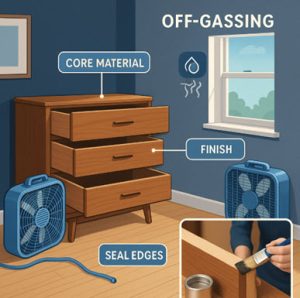
You finally find a dresser that looks great, but the room smells like a paint aisle for days. That smell is off-gassing. It comes from glues, finishes, and even drawer bottoms. You do not need a lab to tame it. You just need to know which parts smell, which finishes are truly calm, and how to air things out the right way.
What is off-gassing, in plain English
Volatile organic compounds are tiny chemicals that turn into vapor at room temperature. Furniture gives them off most during the first days or weeks after finishing or assembly. Heat, sunlight, and poor airflow make it worse. Cooler air and ventilation help a lot.
Where the smell really comes from
1) The core material
-
MDF
Smooth and cheap. Uses more resin. Smell risk is higher, especially at raw edges and inside panels. -
Plywood
Layers of veneer with glue lines. Usually lower odor than MDF when edges are sealed. The edges can still smell if left raw. -
Solid wood
Wood itself has a light natural scent. The finish you put on top is what you notice most.
2) The finish on top
-
Solvent based lacquer or varnish
Fast to spray, can stink for a long time if not cured well. Often the reason new dressers smell “chemical.” -
Water based polyurethane
Much lower odor, cures in days, tough enough for dressers and tables. -
Hardwax oils
Natural-leaning, pleasant scent once cured, easy to repair, not quite as bulletproof as poly against standing water. -
Oil-only finishes (pure tung or linseed, no solvents)
Very low odor but slow to cure. Best on pieces that do not see heavy wear.
3) Hidden surfaces
Undersides, backs, drawer bottoms, and cutouts are often unfinished. Raw edges act like chimneys. Seal them and the smell drops fast.
How to fix a smelly piece in 48 hours
Use this when a new dresser, desk, or nightstand arrives and the odor is noticeable.
What you need: two box fans, a window or balcony, microfiber cloths, mild cleaner, painter’s tape, a cheap carbon or HEPA room filter if you have one.
Day 1
-
Move the piece to the best ventilated room you have. Crack a window.
-
Open every drawer and door. Pull drawers out a few inches.
-
Wipe all interior surfaces with a slightly damp microfiber cloth. You are removing factory dust and residues that hold odor.
-
Set a box fan to pull air out the window. Aim the other fan to push room air across the furniture toward that window.
-
Run a room air filter nearby if available.
-
At night, close the window a little to keep the room comfortable, but keep drawers open.
Day 2
-
Repeat the quick wipe on drawer sides and bottoms.
-
Rotate the piece so air hits the back and underside.
-
Keep fans running in the same push-pull setup for at least 6 more hours.
-
Do a sniff test. If you still notice odor coming from a specific edge or hole, mark it with painter’s tape. Those spots need sealing.
Most pieces improve a lot within two days. If not, go to edge sealing.
Edge sealing that actually works
Raw edges and inside cutouts are tiny odor stacks. Seal them and you cut the vapor path.
Good options
-
Water based polyurethane
Dries fast, low odor. Great for MDF and plywood edges. -
Shellac (dewaxed)
Dries in minutes, blocks odor well. You can topcoat later with anything. -
Hardwax oil
Easy to apply. Best on solid wood edges.
Step by step
-
Lightly sand only the smelly edges with 220 grit. Wipe dust.
-
Brush or wipe a thin coat of your sealer on the edge, underside, back panel edges, and any cable holes.
-
Let it dry with airflow. Repeat for a second coat if the edge still feels porous.
-
Leave drawers open overnight with a fan.
Tip: You usually do not need to coat large visible faces. Edges and hidden panels do most of the work.
Safe-finish cheat sheet
| Goal | Good choice | Why readers like it | Notes |
|---|---|---|---|
| Fast, low-odor seal on MDF/ply edges | Water based polyurethane | Low smell, dries in hours | Satin looks most natural |
| Strong odor blocker on small spots | Dewaxed shellac | Dries in minutes, great odor barrier | Amber tone on light woods |
| Repairable, natural-leaning topcoat | Hardwax oil | Easy to refresh, soft feel | Avoid heavy water exposure |
| Almost zero odor, patient timeline | Pure tung or raw linseed oil | Simple ingredients | Needs weeks to fully cure |
How to choose better furniture before you buy
-
Ask what the finish is. If a brand cannot tell you, that is a sign to pass. Look for “water based finish” or “hardwax oil.”
-
Check the back and the underside. If they are raw, plan to seal them yourself or pick a different model.
-
Prefer plywood or solid wood for enclosed pieces. MDF is fine, but sealed edges matter more.
-
Let it cure. Even low-odor finishes need time. If the item was finished last week, ask the seller to hold it a few extra days.
Simple habits that keep odors low
-
Keep drawers slightly open the first few nights.
-
Run a small carbon filter in bedrooms when new pieces arrive.
-
Avoid scented cover-ups on day one. Vent first, then decide if you even need them.
-
Do a quick yearly check. If an edge chips, reseal that spot and you are done.
What to do if nothing helps
If two days of airflow and edge sealing change nothing, contact the seller. Be specific. “Odor coming from unfinished back panel and cable holes” gets a faster solution than “it smells.” Ask for either a replacement that was cured longer or a return label. Keep your receipts for any sealer you used. Many brands will reimburse simple fixes.
Takeaway
Most “low-odor” furniture is fine once you let it breathe and seal the right edges. Know where the smell comes from, use a 48-hour airflow plan, and seal the raw spots. You will keep the look you love and sleep better the first night it is in your home.